
If you are new to the oil and gas world — or you work in engineering, procurement, or fabrication and want to understand how the industry is structured — this guide is for you.
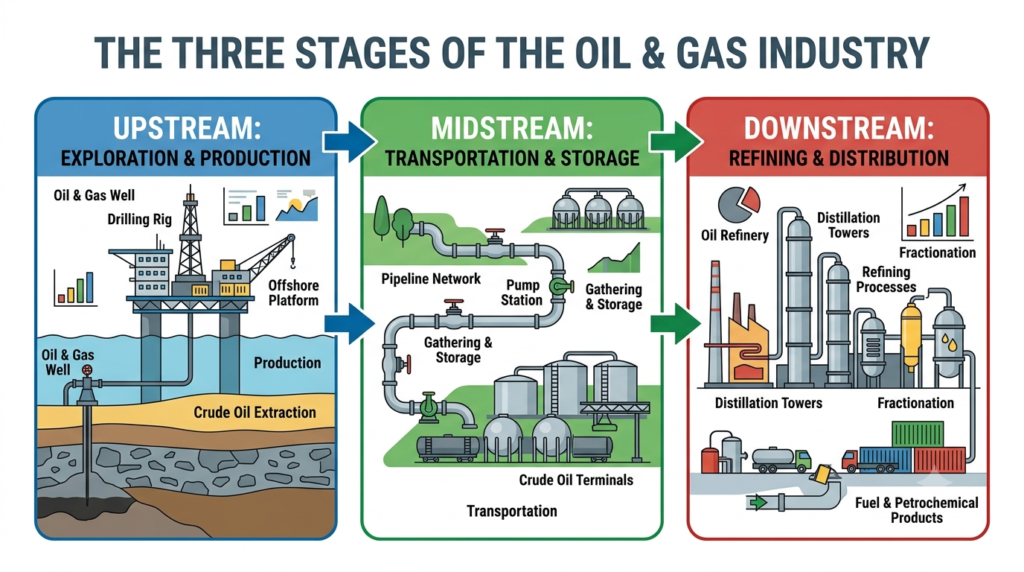
The oil and gas industry is often described in three segments: upstream, midstream, and downstream. These three words appear constantly in job postings, tenders, contracts, and industry conversations. Yet many people outside the sector — and even some inside it — are not entirely sure what each segment covers.
By the end of this article, you will have a clear, practical understanding of what each segment does, how they connect, and why this matters for professionals working in fabrication, inspection, documentation, and certification.
Free Download: Oil & Gas Industry Quick Reference Card — a one-page cheat sheet covering all three segments, key terminology, and the role of standards like ASME. Download link at the end of this article.
Why the Oil and Gas Industry Is Divided Into Three Segments
The oil and gas industry covers an enormous range of activities — from finding oil deep underground to selling fuel at a petrol station. No single company manages all of it in one unified process. Instead, the industry organises itself into three broad stages based on what happens to the oil or gas at each point in the value chain.
Understanding these segments helps you:
- Speak the right language when talking to clients, contractors, or engineers
- Understand which standards and codes apply to your work
- Know where pressure vessels, piping, and fabricated equipment fit in the process
- Position your workshop or services correctly in tenders and proposals
Upstream: Where It All Begins
What Is Upstream?
Upstream refers to the exploration and production phase of the oil and gas industry. This is where companies search for oil and gas reserves, drill wells, and extract the raw material from the ground or seabed.
Key Activities in Upstream
- Seismic surveys to locate underground reservoirs
- Exploratory drilling to confirm whether oil or gas is present
- Well completion and production drilling
- Extraction of crude oil and natural gas
- Initial separation of oil, gas, and water at the wellhead
Where Is Upstream Located?
Upstream operations happen both onshore and offshore. Onshore upstream sites include oil fields in Saudi Arabia, Texas, and Russia. Offshore upstream sites include platforms and floating production units in the North Sea, the Gulf of Mexico, and offshore Qatar.
Equipment Used Upstream
Upstream operations rely heavily on specialised pressure equipment. This includes:
- Wellhead assemblies and Christmas trees
- Separators — vessels that separate oil, gas, and water
- Pressure vessels for initial processing
- Flare stacks and relief systems
- Pumps and compressors
This is where ASME-certified fabrication becomes critical. Pressure vessels used in upstream operations must meet strict codes — typically ASME Section VIII — because they operate under high pressure, high temperature, and in remote or hazardous environments.
Key Point: If your workshop fabricates separators, pressure vessels, or heat exchangers used in oil field operations, you are serving the upstream segment.
Midstream: Moving and Storing the Resource
What Is Midstream?
Midstream refers to the transportation, storage, and initial processing of crude oil, natural gas, and natural gas liquids (NGLs) after they leave the production site. Midstream operations connect upstream production to downstream refining and distribution.
Key Activities in Midstream
- Pipeline transportation of crude oil and natural gas
- Liquefied Natural Gas (LNG) processing and shipping
- Storage in tanks and terminals
- Natural gas processing — removing impurities and separating NGLs
- Compression and pumping stations along pipeline networks
Scale of Midstream Infrastructure
The scale of midstream infrastructure is enormous. Saudi Aramco operates one of the world’s largest pipeline networks. The United States alone has over 300,000 miles of natural gas pipelines. Midstream terminals and storage facilities are found at ports, refinery gates, and distribution hubs worldwide.
Equipment Used Midstream
- Large diameter piping and pipeline components
- Storage tanks — atmospheric and pressurised
- LNG cryogenic tanks and equipment
- Gas processing plants with pressure vessels and heat exchangers
- Compressor stations
Much of this equipment requires ASME certification. Storage vessels, processing equipment, and piping systems all operate under regulated pressure conditions and must be fabricated and inspected to recognised international codes.
Key Point: If your workshop fabricates tanks, storage vessels, pipeline components, or gas processing equipment, you are serving the midstream segment.
Downstream: Turning Raw Material Into Products
What Is Downstream?
Downstream refers to the refining, processing, and distribution of petroleum products. This is where crude oil is converted into products that consumers and industries actually use — fuels, lubricants, chemicals, and plastics.
Key Activities in Downstream
- Crude oil refining into petrol, diesel, jet fuel, and other products
- Petrochemical manufacturing — producing ethylene, propylene, and other base chemicals
- Blending and quality control of finished products
- Distribution through terminals, trucks, trains, and pipelines
- Retail sale at fuel stations
Major Downstream Facilities
Downstream operations are centred around oil refineries and petrochemical complexes. Major examples include:
- The Ras Tanura refinery in Saudi Arabia — one of the world’s largest
- Jamnagar refinery in India — the world’s largest single-location refinery
- Rotterdam as Europe’s largest refining and petrochemical hub
Equipment Used Downstream
- Distillation columns and fractionation towers
- Heat exchangers — shell and tube, plate, and air-cooled
- Reactors and pressure vessels for chemical processing
- Storage spheres and bullets for LPG and other products
- Fired heaters and furnaces
Downstream equipment operates under some of the most demanding conditions in industry — high temperatures, corrosive fluids, and precise pressure requirements. ASME codes and certifications are not optional in this segment. They are required for plant approvals, insurance, and regulatory compliance.
Key Point: If your workshop fabricates reactors, heat exchangers, distillation columns, or storage spheres, you are serving the downstream segment.
How the Three Segments Connect
The oil and gas value chain is a continuous flow:
UPSTREAM → MIDSTREAM → DOWNSTREAM
Raw crude oil and natural gas extracted upstream travels through midstream pipelines and processing facilities to reach downstream refineries. Refined products then move through distribution networks to end users.
Every segment depends on the others. A disruption in midstream transport affects both upstream production and downstream refining. Understanding this interconnection is essential for professionals advising clients across different segments.
Why This Matters for Fabrication Workshops
If you run or work in a pressure vessel or structural fabrication workshop, understanding upstream, midstream, and downstream helps you in three important ways.
1. Understanding Your Client’s Requirements
A client from an upstream oil field has different requirements from a downstream refinery client. Upstream clients may need equipment that is portable, skid-mounted, and rated for remote harsh environments. Downstream clients may need equipment built to specific process standards with detailed documentation packages.
2. Knowing Which Codes Apply
ASME Section VIII Division 1 is the most common pressure vessel code across all three segments. However, downstream petrochemical clients often also reference API 650 for storage tanks, API 660 for heat exchangers, and specific pressure ratings that vary by service.
3. Positioning Your Services
When marketing your workshop or preparing tenders, knowing which segment a client operates in helps you demonstrate relevant experience and certifications. An ASME U Stamp tells a downstream refinery client that your fabrication meets the international standard they require.
The ASME U Stamp is recognised across all three segments of the oil and gas industry as the mark of a qualified pressure vessel manufacturer. Read our full guide: What Is the ASME U Stamp and Why Your Workshop Cannot Enter Oil and Gas Without It. [Link: https://freedocumentshub.com/what-is-asme-u-stamp/]
Key Terminology You Should Know
Here is a quick reference of terms that appear across all three segments:
| Term | Definition |
| Wellhead | The assembly of valves and fittings at the top of an oil or gas well |
| Separator | A pressure vessel that separates oil, gas, and water coming from the well |
| NGL | Natural Gas Liquids — components such as ethane, propane, and butane extracted from natural gas |
| LNG | Liquefied Natural Gas — natural gas cooled to -162°C for transport and storage |
| Refinery | A processing facility that converts crude oil into refined petroleum products |
| Petrochemical | Chemicals derived from petroleum or natural gas used as feedstock for plastics and other materials |
| MAWP | Maximum Allowable Working Pressure — the highest pressure a vessel is designed to handle safely |
| ASME U Stamp | Certification mark authorising a manufacturer to fabricate ASME Section VIII pressure vessels |
Free Download: Oil & Gas Industry Quick Reference Card
To help you remember the key differences between upstream, midstream, and downstream — and to give your team a useful reference document — we have created a free one-page Quick Reference Card.
The reference card covers:
- The three segments and their core activities
- Key equipment types in each segment
- Relevant standards and codes by segment
- Essential terminology every fabrication professional should know
Download the free Oil & Gas Industry Quick Reference Card below. No email required — just click and download.
Summary
The oil and gas industry operates across three interconnected segments:
- Upstream — exploration and production of crude oil and natural gas
- Midstream — transportation, storage, and initial processing
- Downstream — refining, petrochemical production, and distribution
Each segment relies on fabricated equipment — pressure vessels, heat exchangers, storage tanks, piping systems — that must meet international standards. For fabrication workshops targeting this industry, understanding these segments is the foundation for winning clients, interpreting requirements, and delivering compliant work.
If you found this article useful, explore the rest of our series on industrial documentation, ASME certification, and engineering standards for fabrication workshops on freedocumentshub.com.
Related Articles on freedocumentshub.com
- What Is the ASME U Stamp and Why Your Workshop Cannot Enter Oil and Gas Without It
- Industrial Engineering Crash Course — Key Terms Every Professional Must Know [Coming Soon]
- ASME Boiler and Pressure Vessel Code Overview [Coming Soon]
© freedocumentshub.com — Free Resources for Industrial and Engineering Professionals