
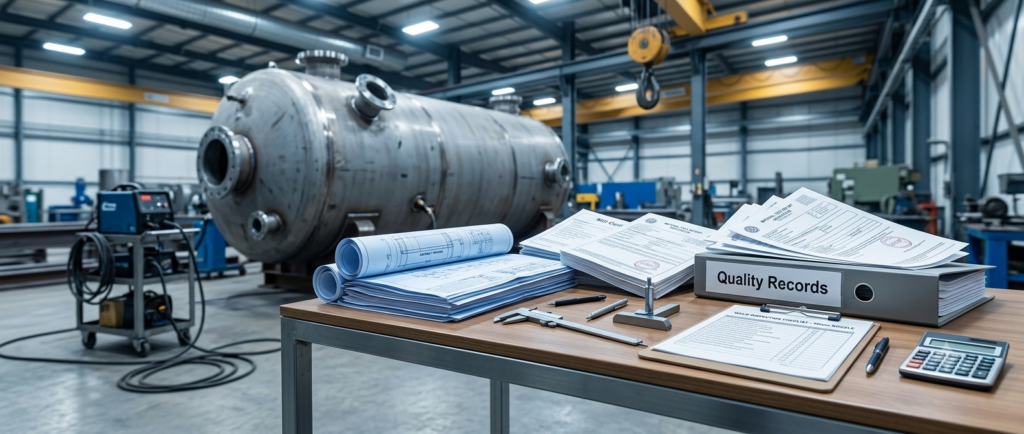
If you run a fabrication workshop — or you are trying to break into the oil and gas industry — you have probably heard the phrase “get your documentation in order.” But what does that actually mean? What counts as industrial documentation? And why do clients, certifying bodies, and regulators care so much about it?
This post answers all of that. By the time you reach the end, you will understand exactly what industrial documentation is, what types exist, why it is non-negotiable in fabrication and manufacturing environments, and what happens to workshops that ignore it.
Whether you are a workshop owner, a quality manager, a fabrication engineer, or a student entering the field — this guide is your starting point.
What Is Industrial Documentation?
Industrial documentation refers to the complete set of written, drawn, and recorded information that supports the design, fabrication, inspection, testing, and handover of industrial equipment and structures.
Think of it as the paper trail (or digital trail) that proves a product was built correctly, safely, and in accordance with the applicable standards.
In a fabrication workshop context, industrial documentation typically includes:
- Engineering drawings and specifications
- Material test reports (MTRs) and mill certificates
- Welding procedure specifications (WPS) and procedure qualification records (PQR)
- Welder qualification records (WQR)
- Non-destructive examination (NDE) reports
- Dimensional inspection records
- Hydrostatic and pneumatic test reports
- Quality control checklists and inspection and test plans (ITPs)
- Purchase orders and traceability records
- Final data books and manufacturer’s data reports (MDR)
This is not an exhaustive list — the exact documentation required varies by project, client, and applicable code. But these are the core categories that every serious fabrication workshop must manage.
Why Does Industrial Documentation Exist?
Industrial documentation was not invented by bureaucrats who wanted to create paperwork. It evolved out of necessity — specifically, out of disasters.
When pressure vessels failed in the early 20th century — boiler explosions, pipeline ruptures, structural collapses — investigators consistently found the same root cause: no one could trace what materials were used, how the equipment was welded, or whether it had ever been properly tested. There was no documentation. There was no accountability.
That is what gave birth to organizations like the American Society of Mechanical Engineers (ASME) and their Boiler and Pressure Vessel Code (BPVC). And at the core of every major industrial standard — ASME, ISO, API, EN — is a documentation requirement. You must be able to prove what you built, how you built it, and that it has been verified.
Today, industrial documentation serves four primary purposes:
1. Safety and Risk Management
Documentation ensures that safety-critical decisions — the choice of base material, the weld procedure, the pressure test parameters — are made deliberately, recorded clearly, and traceable. If a problem occurs during the equipment’s operating life, engineers can review the original documentation to understand what was built and why.
2. Regulatory Compliance
Governments and regulatory authorities in virtually every country require fabricators to maintain documentation as a condition of operating. Facilities that cannot produce required records can face fines, shutdowns, or loss of certification.
3. Client and Contractual Obligations
Every serious oil and gas client — whether it is Saudi Aramco, Shell, TotalEnergies, or a mid-tier EPC contractor — specifies documentation requirements in their contracts. Failure to deliver complete documentation packages means your equipment will not be accepted, your invoice will not be paid, and you will not get repeat business.
4. Quality Assurance and Continuous Improvement
Well-maintained documentation allows workshops to identify patterns — which welders consistently produce acceptable welds, which suppliers deliver materials that meet specifications, where rework most often occurs. This data drives improvement.
The Key Types of Industrial Documentation in Fabrication Workshops
Let us go through the most important document types that a fabrication workshop — especially one working in the pressure vessel or oil and gas sector — must understand and manage.
Engineering Drawings and Design Documents
These are the foundation. Engineering drawings define what is to be built — dimensions, tolerances, material specifications, weld joint details, and more. Without approved drawings, fabrication cannot begin. Every revision must be controlled, and only the latest approved revision should be in use on the shop floor.
In ASME U Stamp work, drawings must bear the engineer’s stamp and must be part of the Design Specification and User’s Design Specification that forms the basis of the vessel design.
Material Test Reports (MTRs) and Mill Certificates
Every piece of material used in a code-compliant pressure vessel or structural assembly must be traceable to a material certificate. The MTR (also called a mill certificate) is issued by the steel mill and contains the chemical composition and mechanical properties of the material, verified through testing.
Why does this matter? Because ASME, API, and other codes specify allowable stress values based on material grades. If you cannot prove your material meets the grade — with a proper MTR — your fabrication is not code-compliant, regardless of how well it was welded or tested.
Welding Procedure Specifications (WPS) and Procedure Qualification Records (PQR)
Welding is arguably the most documentation-intensive activity in fabrication. Before any production welding begins on a code job, the welding process must be qualified.
The process works as follows:
- A Welding Procedure Specification (WPS) is written — it prescribes the essential variables: base material, filler material, preheat, interpass temperature, travel speed, position, and more.
- A test weld is performed following the WPS.
- The test weld is subjected to destructive and/or non-destructive testing.
- The results are recorded in a Procedure Qualification Record (PQR).
- If the PQR results meet code requirements, the WPS is considered qualified and can be used for production welding.
Under ASME Section IX, which governs welding qualification, the WPS and PQR are mandatory documents that the Authorized Inspector (AI) will review. Without them, your workshop cannot demonstrate that your welding processes produce sound welds.
Welder Qualification Records (WQR)
In addition to qualifying the procedure, the individual welders who perform production welds must also be qualified. A Welder Qualification Record (WQR) — sometimes called a Welder Performance Qualification (WPQ) — documents the results of a welder’s qualification test.
Welders must be qualified for the specific process, position, and material type they will encounter in production. A welder qualified for flat position (1G) is not automatically qualified to weld in the overhead position (4G). These distinctions matter, and the documentation must reflect them.
Non-Destructive Examination (NDE) Reports
NDE — also called NDT (non-destructive testing) — encompasses techniques for examining materials and welds without damaging them. Common NDE methods include:
- Radiographic Testing (RT) — using X-rays or gamma rays to image internal weld quality
- Ultrasonic Testing (UT) — using sound waves to detect internal flaws
- Magnetic Particle Testing (MT) — detecting surface and near-surface flaws in ferromagnetic materials
- Liquid Penetrant Testing (PT) — detecting surface-breaking discontinuities in any material
- Visual Inspection (VT) — the most basic and always required form of examination
For each NDE activity, a formal report must be produced by a qualified and certified technician. The report records the technique used, the extent of examination, the acceptance criteria applied, and the results — including any defects found and any repairs performed.
Hydrostatic and Pneumatic Test Reports
Pressure vessels must be pressure-tested before they are put into service. Under ASME Section VIII Division 1, this is typically a hydrostatic test at 1.3 times the maximum allowable working pressure (MAWP). The test report records the test pressure, the duration, the temperature, and the results.
This document is one of the last in the fabrication sequence — and without it, the vessel cannot be stamped and released.
Inspection and Test Plans (ITPs)
An Inspection and Test Plan (ITP) is a master document that lists every inspection and test activity that must be performed during fabrication, along with the responsible party (fabricator, third-party inspector, client representative) and the required hold points or witness points.
A Hold Point means fabrication cannot proceed past that point until the inspection has been completed and signed off. A Witness Point means the relevant party must be notified and given the opportunity to witness, but work can proceed if they do not respond within a specified time.
The ITP is the roadmap for the quality control process. Without it, inspections happen inconsistently, hold points get bypassed, and the final documentation package is incomplete.
Final Data Books and Manufacturer’s Data Reports (MDR)
At the end of fabrication, all of the above documents are compiled into a final data book — also called a Manufacturer’s Data Report or MDR. This is the comprehensive record of everything that happened during fabrication.
For ASME-stamped vessels, the MDR includes the official ASME Form U-1 (Manufacturer’s Data Report for Pressure Vessels), which is a legally required document signed by the Manufacturer and the Authorized Inspector. This document stays with the vessel for its entire operating life.
The Difference Between Documentation and Record-Keeping
A common misconception in smaller workshops is that “having the documents” is enough. It is not.
Industrial documentation must be:
- Current — using the latest approved revision
- Controlled — with defined processes for issuing, revising, and withdrawing documents
- Traceable — each document linked to the specific equipment, heat number, weld joint, or activity it covers
- Retrievable — organized so that any document can be located quickly during an inspection or audit
- Retained — stored for the required period (ASME requires at least 3 years for most records; some clients require 10–20 years)
Document control is itself a discipline — and it is one of the first things an Authorized Inspector or third-party auditor will assess when they arrive at your workshop.
What Happens to Workshops That Lack Proper Documentation?
The consequences of poor documentation are real and they affect workshops at every stage of their work.
During Fabrication
- Hold points get bypassed because there is no ITP to enforce them.
- Wrong material gets used because MTRs were not checked or traceability was lost.
- Unapproved welding procedures get used because WPS documents are not properly controlled.
- Defects go undetected because NDE is not performed at the correct stage.
At Handover
- Clients reject the equipment and refuse payment until documentation is completed.
- The Authorized Inspector refuses to sign off on the ASME Form U-1.
- Shipment is delayed, causing liquidated damages under the contract.
- The ASME Certificate of Authorization is at risk if non-conformances are documented.
During Operation
- If an equipment failure occurs and documentation is missing, the workshop (manufacturer) may face full liability.
- Insurance claims are rejected when traceability cannot be established.
- Regulatory authorities can mandate equipment shutdown or replacement at the operator’s expense.
None of these scenarios are hypothetical. They happen — and they most frequently happen to workshops that treated documentation as an afterthought.
Industrial Documentation and Certification: The Connection
If you are pursuing — or already hold — an ASME U Stamp Certificate of Authorization, you already know that the ASME Quality System must be documented. The ASME Quality System Manual (QSM) is itself a documentation requirement.
The QSM must describe how your workshop controls:
- Design and drawing control
- Material control and identification
- Examination and inspection
- Welding and NDE procedures
- Non-conformance control
- Calibration of measuring and test equipment
- Document control and records management
In other words, documentation is not just one part of the ASME certification system — it is the foundation that every other element is built on.
Similarly, ISO 9001-certified workshops, API-licensed manufacturers, and workshops operating under EN 13445 or PED (Pressure Equipment Directive) requirements all share the same underlying principle: you must document what you do, and do what you document.
How Fabrication Workshops Should Think About Documentation
For many smaller workshops, documentation starts as a compliance burden — something done to satisfy the inspector, not something done because it adds value. This is the wrong mindset, and it leads to poor documentation culture.
The most competitive fabrication workshops — the ones that win long-term contracts with major oil and gas operators — treat documentation as a competitive advantage.
Here is why:
- Good documentation reduces rework — problems are caught early because inspections are systematic.
- Good documentation speeds up handover — complete data books mean clients can accept equipment quickly.
- Good documentation builds client confidence — detailed, well-organized records signal a professional, mature workshop.
- Good documentation protects the workshop — in case of any dispute or claim, you have the evidence.
The shift from “documentation as a burden” to “documentation as a business tool” is one of the most important mindset changes a fabrication workshop owner or quality manager can make.
Where to Find Documentation Templates and Guides
One of the most common challenges workshops face is not knowing where to start. What should a WPS look like? How should an ITP be structured? What must go into a final data book?
That is exactly what freedocumentshub.com is built for. Our library of industrial documentation templates, guides, and references is designed specifically for fabrication workshops in the oil and gas and pressure vessel sectors.
Whether you need a starting point for your ASME Quality System Manual, a WPS template aligned with ASME Section IX, or a data book checklist for your next pressure vessel project, you will find it here.
Conclusion: Documentation Is Not Optional
Industrial documentation is not a nice-to-have. It is not a box to tick before the inspector arrives. It is the system that makes modern industrial fabrication safe, reliable, accountable, and competitive.
For fabrication workshops that want to serve the oil and gas industry — or any serious industrial sector — the ability to generate, control, and deliver complete and accurate documentation is as important as the ability to weld, cut, and assemble.
In the rest of this blog series, we will go deeper into specific areas: ASME standards, NDT technology, ASME U Stamp certification, and more. But all of those topics sit on the same foundation — and that foundation is industrial documentation.
If this post was helpful, explore the related guides and templates on freedocumentshub.com — and follow along for the rest of the series.